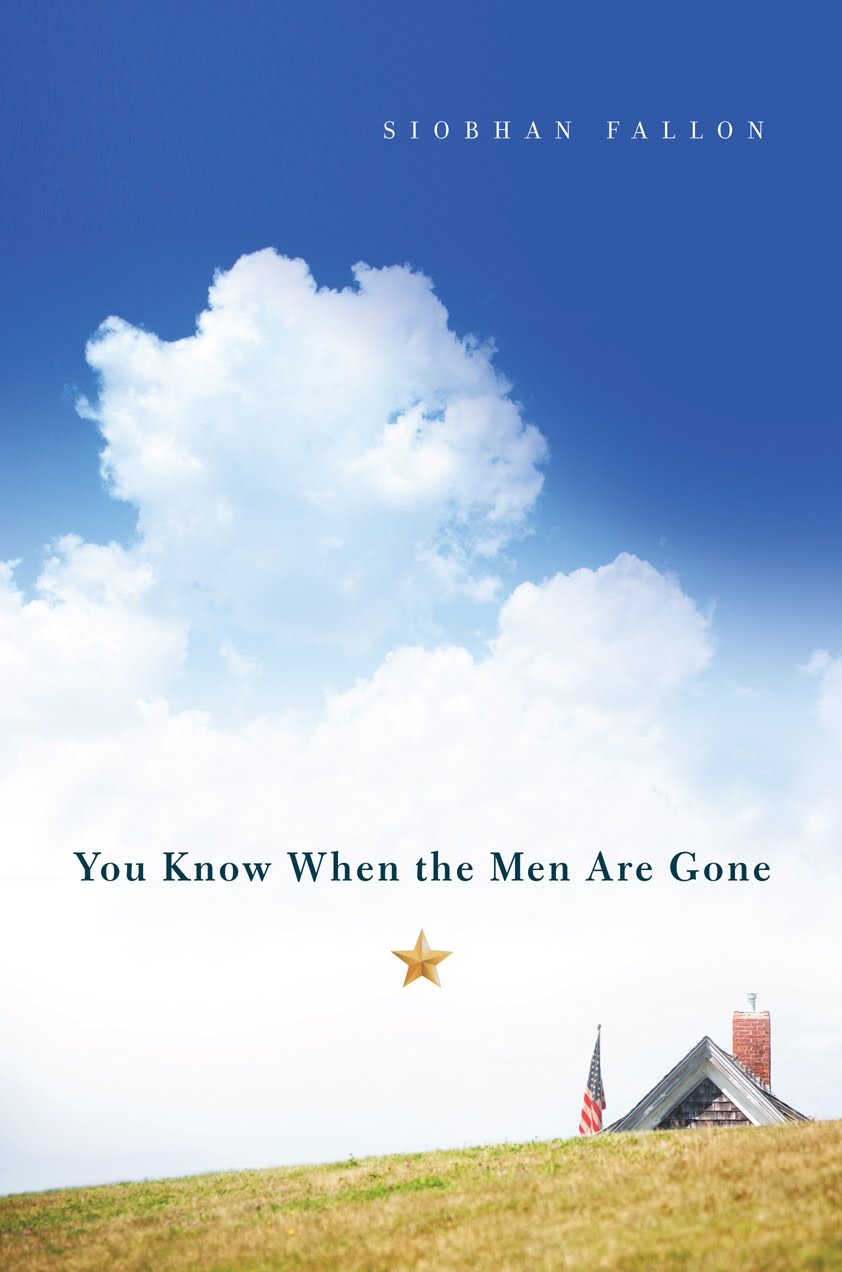
Author Siobhan Fallon's recently released novel is a collection of short stories about the army base Fort Hood in Austin, Texas.
In her book You Know When the Men Are Gone, she focuses on the often underrepresented aspects of war. The battle for sanity on the home front.
A truly engaging novel by a truly engaging person, Siobhan spoke about the difficulties of being a military wife, and the life that accompanies it.
Because I am a a student of literature, one of the most exciting aspects of this interview to me was to actually speak with the source. I am currently enrolled in the class Theory & Interpretation taught by Professor Jody Greene which centralizes around the idea of authorship and questions if the author is necessary when determining intent or hermeneutics. Although many of the theorist believe that an author should be removed from a text, I found it helpful to speak with Siobhan about her influences when writing the text- especially when they were not explicitly referenced.
When reading "You Know When The Men Are Gone" I was struck with the parallels between her writing and that of "The Things They Carried" by Tim O'Brien. When I brought this comparison up, she admitted she had hoped the novel would be something of the female version of O'Brien's famous text and was thrilled I had made the connection. She said no one had made the observation of the similarities between the two books that she had intended and thought was obvious.
Overall it was an insightful interview. I found it particularly intriguing when she revealed that many of the characters represented her in different stages of her life. The idea that one can channel emotions and opinions through fictionalized characters is a fascinating concept.
Siobhan moves to Saudi Arabia in a few weeks, where she is optimistic she will find more writing material; perhaps even a new novel, which I eagerly await.
Click Below to here the full interview aired 3/3/11
Interview with Siobhan Fallon
Thursday, March 3, 2011
Thursday, February 24, 2011
Blast from The Past: Vinton Cerf and Mai Vu
I first began volunteering at the radio station in the fall of my freshman year and quickly became intrigued by the public affairs program. Although I never considered myself a journalist, I enjoyed speaking with others about various events in the community and editing the recordings together to produce radio pieces.
For the better part of that year I produced 5-10 minute news pieces for the KZSC News which aired every Thursday night. The more I produced pieces, the more I realized how much I enjoyed strictly interview based pieces and moved towards longer, "features" pieces which centralized around one person.
Vinton Cerf: Father of the Internet
The first of these was my interview of Vinton Cerf, Vice President and Chief Evangelist of Google. This man created the first e-mail, and is known as "the father of the internet". In December 1997, President Clinton presented the U.S. National Medal of Technology to Cerf and his colleague, Robert E. Kahn, for founding and developing the Internet. In November 2005, President George Bush awarded Cerf and Kahn the Presidential Medal of Freedom for their work. The medal is the highest civilian award given by the United States to its citizens. No big deal.
For the better part of that year I produced 5-10 minute news pieces for the KZSC News which aired every Thursday night. The more I produced pieces, the more I realized how much I enjoyed strictly interview based pieces and moved towards longer, "features" pieces which centralized around one person.
Vinton Cerf: Father of the Internet
The first of these was my interview of Vinton Cerf, Vice President and Chief Evangelist of Google. This man created the first e-mail, and is known as "the father of the internet". In December 1997, President Clinton presented the U.S. National Medal of Technology to Cerf and his colleague, Robert E. Kahn, for founding and developing the Internet. In November 2005, President George Bush awarded Cerf and Kahn the Presidential Medal of Freedom for their work. The medal is the highest civilian award given by the United States to its citizens. No big deal.
In December, 1994, People magazine identified Cerf as one of that year's "25 Most Intriguing People."
It was truly a privilege to interview him and during our talk we focused on the current state of Google and what projects the company has for the future.
The interview originally aired May 5th 2010 but was re-aired as a throwback on February 24, 2011
Click to listen to the Vinton Cerf interview
Below is a photograph of Vinton Cerf "Godfather of the Internet"
Mai Vu: Vietnam Escapee
The other interview I chose to re-air highlighted one of the untold stories of an immigrant.
I spoke with Mai Vu who escaped Vietnam after the communist revolution during the war. At ten years old Mai and her family pushed off into the Pacific Ocean in a tug boat with 30 others in the middle of the night and was eventually rescued by a Japanese cargo ship.
Although it's been nearly 35 years since her escape, Mai speaks about the event in vivid detail. We also spoke about some of the challenges immigrants faced in the past and present day along with the differences of cultural change.
The piece originally aired on May 27th 2010 and was re-aired with Vinton Cerf's piece on February 24th, 2011.
Click below to listen to the original interview of Mai Vu
Below is a photograph of Mai Vu practicing yoga at "Downtown Yoga" in her hometown of Pleasanton, California
Thursday, February 17, 2011
Interview with Jenna Purcell: Random With a Purpose XIX
A conversation does not necessarily need words.
Although I spoke to Jenna Purcell hours before the opening of the student run, student choreographed student produced dance show, Random With a Purpose, I felt I only truly understood her when I saw her perform her dance.
Jenna Purcell, director of the production, spoke with me about the history of random, the importance of having a dance program on the UC Santa Cruz campus and how the the sense of community that "Random" provides has made this an enjoyable experience for her.
I went to see one of the dress rehearsals so I could speak with Jenna privately and was blown away by the amount of talent within my peers. I was recognized a few of the dancers from past classes and was shocked and delighted to see them express their talent and to have an outlet to do so.
Below is a photograph of Jenna Purcell during her solo performance during this year's production.
Click here to listen to the interview with Jenna Purcell about Random With a Purpose XIX aired 2/17/11
Interview with Jenna Purcell
Although I spoke to Jenna Purcell hours before the opening of the student run, student choreographed student produced dance show, Random With a Purpose, I felt I only truly understood her when I saw her perform her dance.
Jenna Purcell, director of the production, spoke with me about the history of random, the importance of having a dance program on the UC Santa Cruz campus and how the the sense of community that "Random" provides has made this an enjoyable experience for her.
I went to see one of the dress rehearsals so I could speak with Jenna privately and was blown away by the amount of talent within my peers. I was recognized a few of the dancers from past classes and was shocked and delighted to see them express their talent and to have an outlet to do so.
Below is a photograph of Jenna Purcell during her solo performance during this year's production.
Click here to listen to the interview with Jenna Purcell about Random With a Purpose XIX aired 2/17/11
Interview with Jenna Purcell
Friday, February 11, 2011
Interview with J Michael Mahoney: Schizophrenia: The Bearded Lady Disease
On Saturday January 22nd, 2011 I traveled over the hill to meet with psychologist J. Michael Mahoney.
Mr. Mahoney recently released a controversial theory dealing with the origins of the mental disease, Schizophrenia. In his book Schizophrenia: The Bearded Lady Disease he suggests that all mental illness -specifically schizophrenia- stems from the repression of sexual urges.
Although this may come across as a jarring notion, in his book, Mahoney has spent nearly 40 years collecting nearly 700 pieces of evidence from various studies of schizophrenic patients that he believes proves his theory.
In the interview we spoke about the then recent Arizona shootings by Jared Laughner, an individual suspected to be mentally unstable. Mahoney believes he had not come to terms with his sexuality and was thus driven to insanity.
We also spoke about his poem dealing with circumcision, which is still a subject of controversy in current day.
All proceeds from the book are donated to a scholarship foundation at Yale University so that young adults can continue to question the world around them.
Overall, J. Mike Mahoney was a kind, elderly gentlemen who often drew parallels to himself and Darwin. He said, "Darwin developed a hypothesis and spent his whole life collecting information to support it, that's all I'm doing!"
He also, unsurprisingly, is a student of Freudian theory. I had to move a pillow with Freud's face on it aside in order to sit comfortably on his couch in Larkspur, California.
Click to listen to our interview which aired February 11th, 2011
Interview with J. Michael Mahoney
Photographed below is J. Michael Mahoney. When I met him he was wearing a red button down shirt. The same goes for this picture. And every photograph taken of him. Ever.
Below is a link to his website in which one can view the book and his other works.
Thursday, February 3, 2011
Interview with Halfdan Hussey
On Thursday, Februrary 3, 2011 I traveled over the hill, out of safe Santa Cruz to San Jose, where I met with director of the film festival, Cinequest, Halfdan Hussey
Cinequest is a non-profit film festival that showcases dozens or independently sponsored films as well as awarding Maverick spirit award for those who have particularly influenced the independent film community.
After I interviewed Halfdan at the Cinequest headquarters, he offered me the privilage of interviewing a celebrity that will come to accept the Maverick Spirit award. More to come on that.
This audio segment was taken off the KZSC blog. The first half an hour is my interview and then the rest of the file moves into the KZSC news. It begins with the song "Let's go to the Movies" from the musical, Annie.
Click on link below to listen to Interview with Halfdan Hussey, the segment aired Thursday February 3, 2011
Interview with Halfdan Hussey
Cinequest is a non-profit film festival that showcases dozens or independently sponsored films as well as awarding Maverick spirit award for those who have particularly influenced the independent film community.
After I interviewed Halfdan at the Cinequest headquarters, he offered me the privilage of interviewing a celebrity that will come to accept the Maverick Spirit award. More to come on that.
This audio segment was taken off the KZSC blog. The first half an hour is my interview and then the rest of the file moves into the KZSC news. It begins with the song "Let's go to the Movies" from the musical, Annie.
Click on link below to listen to Interview with Halfdan Hussey, the segment aired Thursday February 3, 2011
Interview with Halfdan Hussey
Below: Halfdan Hussey, Co-Founder and Executive Director of Cinequest
Thursday, January 27, 2011
Interview with Terrence Roberts
Terrence Roberts one of the original Little Rock Nine speaks of racism, prejudice and other issues in current day American society.
It was truly a pleasure to interview someone who is so essential to the Civil Rights Movement, a movement that Roberts believes is still going on and will continue to go on until the public begins to change their ways of viewing others.
Truly an intriguing talk by a gifted speaker.
Below is a photograph of Terrence Roberts waiting outside Little Rock High School waiting for admission and being faced with resistance by the state police. This photograph was taken in 1957.
Terrence was 15 at the time
Doctor Roberts was one of the first nine black students to integrate into a largely white high school in Little Rock Central High School in Little Rock, Arkansas.
Although they were within their rights since the Brown v. Board of Education Supreme Court decision overturned the original ruling of Plessy v. Freguson which enforced segregated schooling as long as they were “separate but equal”. Brown ruled that they were inherently unequal and thus legalized integrated schooling. However, old habits die hard. The state of Arkansas disapproved of this ruling so adamately that when the nine students attempted to exercise their right of getting an education, the National Guard barred them from entry on orders of the governor. Some weeks later after the nine students were continuously refused entry, President Eisenhower ordered the National Guard to protect the students in order to uphold the law.
It was truly a pleasure to interview someone who is so essential to the Civil Rights Movement, a movement that Roberts believes is still going on and will continue to go on until the public begins to change their ways of viewing others.
Truly an intriguing talk by a gifted speaker.
Click below to listen to the Interview with Terrence Roberts aired January 27th, 2011.
Below is a photograph of Terrence Roberts waiting outside Little Rock High School waiting for admission and being faced with resistance by the state police. This photograph was taken in 1957.
Terrence was 15 at the time
Thursday, January 20, 2011
Interview with Larry Johnson
Yesterday, January 20th 2011, I sat down with Larry Johnson, founder of KZSC radio station in 1967, to talk to him about his experiences with radio and how radio "plays" into our lives in present times.
Larry started KRUZ, now KZSC, out of the basement of Stevenson 2 dorms, where he blasted music from a trash can as an antenna and egg cartons lining the walls as insulation.
He spoke about starting it up, some of the legal trouble, and the entire feel behind the era.
In the second part of the interview we focused on what it means to be a DJ in current times. Why is broadcasting a novelty?
Overall very successful and a great way to kick off the new show.
Interview is in the second half of the show.
Larry started KRUZ, now KZSC, out of the basement of Stevenson 2 dorms, where he blasted music from a trash can as an antenna and egg cartons lining the walls as insulation.
He spoke about starting it up, some of the legal trouble, and the entire feel behind the era.
In the second part of the interview we focused on what it means to be a DJ in current times. Why is broadcasting a novelty?
Overall very successful and a great way to kick off the new show.
Interview is in the second half of the show.
Cheers!
Click here to listen to the interview that aired 1/20/11
Below is a Photo of Larry Johnson and myself after the interview.
Subscribe to:
Posts (Atom)